
AI Projects Don't Fail at Your Size. They Go Underground.
The famous AI failure statistics (95%, 80%, 42%) were measured on enterprises running $5M to $20M deployments, not firms your size. At $1M to $20M a failed AI project rarely gets cancelled. The official tool dies, and a few people keep using AI off the books, with no oversight.

You've seen the numbers. 95% of AI pilots fail. More than 80% of AI projects fail. 42% of companies abandoned most of their AI initiatives in 2025. The numbers are real, and each comes from serious research. Almost nobody quoting them mentions that none of those studies measured a firm like yours.
I write for owners of service firms between $1M and $20M in revenue. At that size, the famous statistics describe a different animal. An enterprise AI project that fails gets cancelled, written off, and counted in a survey. A service-firm AI project that fails goes underground. The official tool dies, and the AI keeps getting used, by a few people, off the books, with no oversight.
Why do AI projects fail?
AI projects fail for organizational reasons far more often than technical ones. RAND interviewed 65 experienced data scientists and engineers about failed AI projects and found five root causes: a misunderstood problem, inadequate data, focusing on the latest technology instead of the real problem, inadequate infrastructure, and aiming AI at problems it can't yet solve. Four of the five live in the organization. The fifth is a targeting error, and picking the wrong target also happens in a meeting room, long before any model runs.
MIT's researchers reached the same place from a different direction. Their 2025 report on enterprise GenAI names the core issue as a "learning gap" for both tools and organizations, not the quality of the AI models. Generic tools work well for individuals and stall inside companies, because they never learn the firm's workflows.
Across the firms I've observed, the whole literature compresses into four requirements. An AI project needs money, time, people, and alignment. Miss any one and the project is a bust. I'll come back to these. First, the statistics deserve a closer read than they usually get.
What do the famous AI failure statistics actually measure?
The 95% comes from MIT NANDA's "The GenAI Divide: State of AI in Business 2025". What it says: "95% of organizations are getting zero return" from GenAI pilots, meaning no measurable P&L impact yet. The basis was interviews with 52 organizations, a survey of 153 senior leaders, and a review of more than 300 public AI initiatives. The authors call their own figures "directionally accurate." A pilot with no P&L return six months in is a disappointment. It is a different thing from a failed project, and MIT never claimed 95% of AI projects fail. The people quoting it that way have read the headline, and the headline only.
The 80% comes from RAND: "By some estimates, more than 80 percent of artificial intelligence (AI) projects fail. That is twice the rate of failure for information technology (IT) projects that do not involve AI." The study is qualitative, built on those 65 interviews, so treat the 80% as directional. Twice the normal IT failure rate is the part worth keeping.
The 42% is the sturdiest of the set. S&P Global surveyed over 1,000 IT and business leaders and found the share of companies abandoning most of their AI initiatives jumped to 42% in 2025, up from 17% a year earlier. The doubling is the story. Companies moved fast in 2024, and the bill for skipped groundwork arrived in 2025.
The 30% and 40% are predictions, and Gartner made both about a specific kind of company. At least 30% of GenAI projects abandoned after proof of concept, and over 40% of agentic AI projects cancelled by end of 2027. Read the fine print in the first release: Gartner prices these deployments at $5 million to $20 million. That detail tells you whose failures are being predicted.
| Statistic | Who measured it | What it measured | What it does not mean |
|---|---|---|---|
| 95% | MIT NANDA, 2025 | GenAI pilots with no measurable P&L return yet, across 52 organizations | 95% of AI projects fail |
| 80%+ | RAND, 2024 | Estimated AI project failure, from 65 practitioner interviews | A precise failure rate |
| 42% | S&P Global, 2025 | Companies abandoning most AI initiatives, 1,006 leaders surveyed | Anything about firms under $100M |
| 30% and 40% | Gartner, 2024 and 2025 | Predictions for GenAI and agentic projects costing $5M–$20M | A measurement of anything yet |
Do the AI failure statistics apply to small firms?
The datasets skew large, all of them. McKinsey's State of AI survey splits respondents by revenue, and its smallest cohort is firms under $100 million. Even inside that cohort, only 29% had reached the scaling phase, against nearly half of firms above $5 billion. The survey's floor sits five times above the ceiling of the firms I write for.
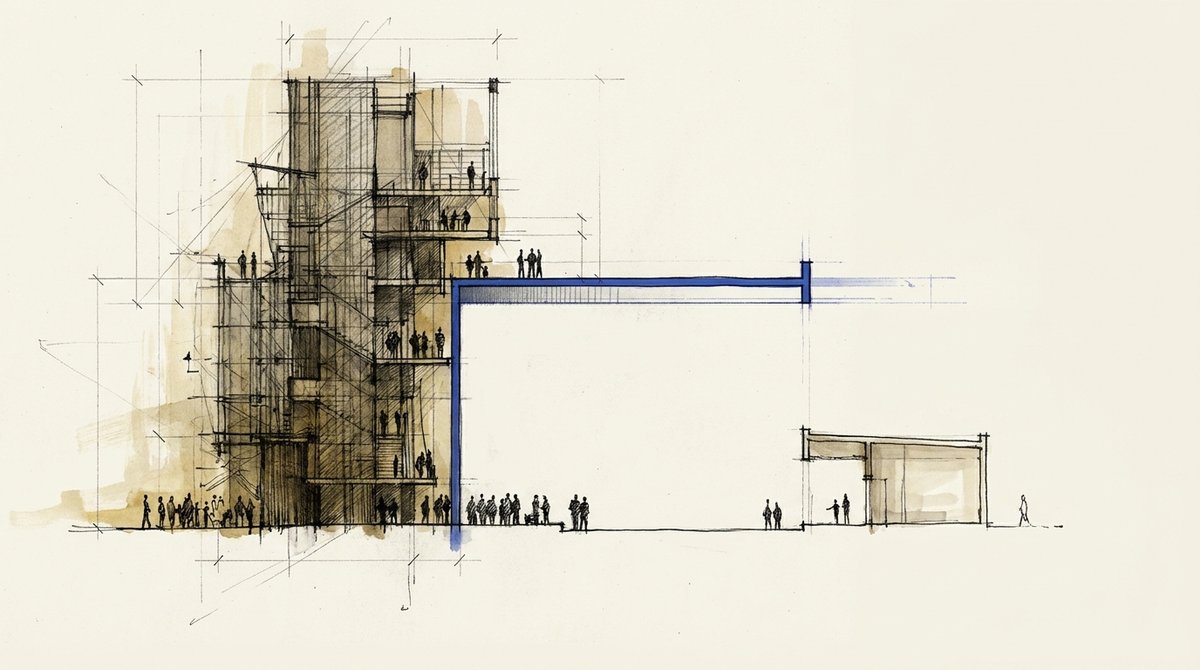
Adoption data shows the same skew from the other side. The OECD's 2025 report on AI adoption by SMEs found 40% of firms with 250 or more employees using AI, against 11.9% of firms with 10 to 49 employees. Most firms your size haven't run a project big enough to fail in the way the studies count.
So the honest reading is narrow. The percentages don't transfer to your firm. The root causes do, and they play out on a budget the studies would consider a rounding error. Your AI project is a few seats, one workflow, and somebody's Tuesday afternoons. When it fails, no analyst records it.
The three shapes I keep seeing
I've watched hundreds of service firms adopt AI through a franchise network's delivery data, and the failed projects repeat three shapes. These are patterns from that vantage point, not survey statistics.
Top-down, no buy-in. Leadership gets excited and spends the money, buying a tool or building one. The team gets errors, bad UX, and no training. Within a quarter the tool stops being a capability and becomes a contention point between management and staff. Usage numbers get quoted in meetings as evidence of a stubborn team. The team reads the same numbers as evidence of a bad tool. Both are partly right, and the project dies in the argument.
Right intent, wrong fit. Everyone wants this one to work, leadership and staff both. The firm buys a serious product, and then discovers it can't be customized to how the work flows. People bend their workflow around the tool for a few weeks, out of goodwill. Goodwill runs out. They drift back to ChatGPT, Gemini, and Claude, which bend to fit anything. This is MIT's learning gap wearing street clothes: the generic tool wins with individuals and the purchased system stalls, because neither one ever learned the firm's workflow. Only one of them was flexible enough to be bent by hand.
Bottom-up, unfunded. The staff want the capability and leadership won't fold in the money. The firm buys the cheap wrong thing, or assigns a developer to build an internal version that ships lackluster and half-finished. MIT's numbers say how this branch ends: purchased tools from specialized vendors reached deployment about 67% of the time, internal builds about 33%. The internal build limps for a while, and the people who wanted the capability go get it themselves from external tools.
Notice the ending all three share: the firm never winds up without AI.
The project dies. The AI keeps working.
After the official project fails, will everyone in the company keep using AI on their own? Maybe not. Will someone, or a few? Absolutely. Every one of the three shapes above ends with the sanctioned tool dead and pockets of people quietly running their own. The failure state of an AI project at your size is unmanaged AI use, and that has a name: shadow AI.
This is why the failure is so hard to see from the owner's chair. An enterprise failure is legible. A line item gets cancelled, a survey box gets ticked, S&P counts it. At your size the signal is muddy. Some usage persists, so the project never quite reads as dead. Nothing is sanctioned, so nothing gets managed. The survivors hide the corpse.
The cost structure of this state is worse than a clean kill. The firm already paid for the failed project. Now it pays again in the improvised work running underneath, where client output skips review and nothing anyone learns turns into a standard. Five people using five private workflows produce five different qualities of output under one brand. I've written about what that looks like in practice, and the test from the Production Gap's Owner Ceiling mode applies here: ask your staff what tools they already use. Asking whether they use any will get you a polite no and teach you nothing.
What does an AI project need to succeed?
The preflight list is short. Money, time, people, alignment. Miss one and the project busts. Each of the three shapes above is one of these gone missing.
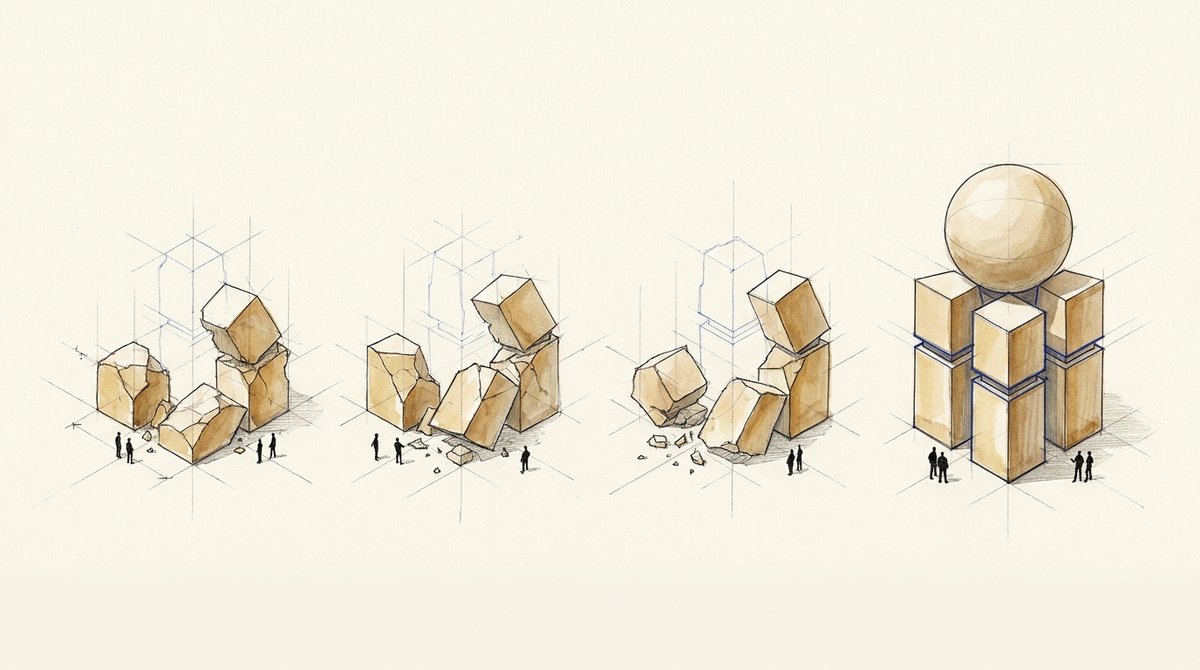
Money is the obvious one, and the bottom-up shape shows what its absence buys: the cheap wrong tool or the half-built internal one.
Time is the one leaders skip most. People need hours off their normal functions to be trained and to practice, and those hours have to come off delivery capacity on purpose. In the Production Gap taxonomy this is the Unfunded Hour: seats bought, willing people, and a learning curve nobody scheduled. Enthusiasm plus licenses minus protected time equals a tool nobody opens.
People means the team is in the project, trained and heard, with the workflow redesigned around them. McKinsey's survey found intentional workflow redesign had one of the strongest measured contributions to AI impact of any factor tested. Buying a tool changes nothing by itself.
Alignment means leadership and staff want the same project. The top-down shape is leadership sprinting alone, the pattern the Production Gap calls the Enthusiasm Flood. The bottom-up shape is the Owner Ceiling, staff ready and the firm's official pace set by the owner's personal one. McKinsey again: high performers are three times more likely to report senior leaders who own and commit to their AI initiatives.
On the Delivery Model Ladder these failures all live at Stage 0 and Stage 1: experiments that never became an owned workflow, or a tool bolted onto a process nobody redesigned.
Failing at your size is cheap. Failing blind is not.
Here is the part of the size gap that works in your favor. When Gartner's predicted abandonments land, each one takes $5 million to $20 million with it. Your failed pilot costs a few thousand dollars and a bruised month. You can afford more attempts than any company in those studies, run faster, on real work, with the people who will use the thing.
The advantage has one condition: a failed attempt has to produce a verdict. Which requirement was missing, money, time, people, or alignment? A project that dies in a meeting and quietly moves underground produces no verdict at all. The firm learns nothing, keeps paying, and the next official attempt starts against a workforce that already routed around the last one.
So treat the four requirements as a preflight check before the next project, and if a past project already died, assume the AI didn't die with it. Ask the team what they already use. The workflows quietly working in the shadows are the best starting material the next official attempt will ever get. The Production Gap maps the eleven ways rollouts stall after that, each with an early-warning sign you can check before the quarter closes.
FAQ
Do 95% of AI projects really fail?
No. The MIT NANDA figure means 95% of enterprise GenAI pilots showed no measurable P&L return as of mid-2025. The report's authors call the number "directionally accurate," and it says nothing about small service firms.
What happens after a small firm's AI project fails?
The official tool gets quietly dropped, and a few people keep using AI on their own, with no review step and no shared workflow. The next attempt should start by finding that use: ask staff what tools they already run, then standardize from what works.
How much does a failed AI project cost a service firm?
Usually a few thousand dollars in seats and builds, plus the hours spent, against the $5 million to $20 million Gartner attaches to enterprise GenAI deployments. The bigger cost is failing without a verdict on which requirement was missing.
When should a firm try again after a failed AI project?
After it can name which of the four requirements was missing: money, time, people, or alignment. Restarting without that diagnosis reruns the same failure with a newer tool.
I track these patterns in the newsletter as the case bank grows. If your firm's last AI project is officially alive and nobody has touched it in a month, you already know which statistic you're in. It just isn't one anybody published.


